The Only Man on Earth to Witness Both Atomic Bombs — and Somehow Walk Away
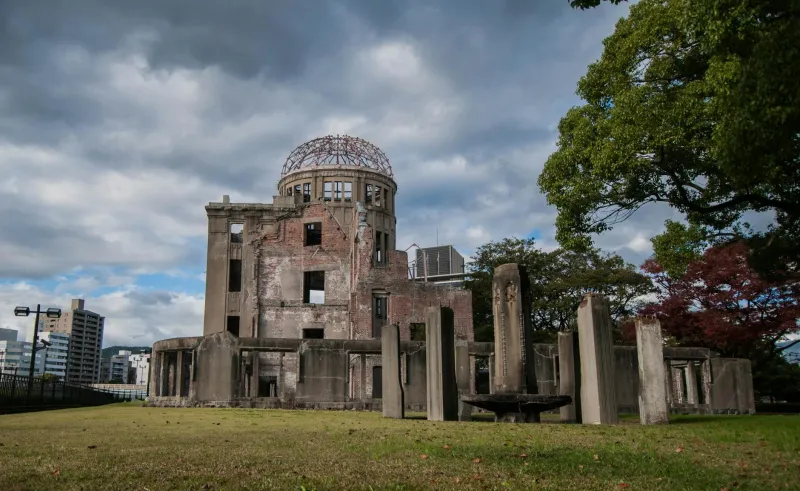
When Lightning Strikes Twice — Literally
Imagine being struck by lightning and living to tell the tale. Now imagine it happening again the very next week. That's essentially what happened to Tsutomu Yamaguchi, except instead of lightning, it was atomic bombs — and the odds were infinitely worse.
On August 6, 1945, Yamaguchi was wrapping up a three-month business trip in Hiroshima for Mitsubishi Heavy Industries. He was a naval engineer, 29 years old, with a wife and infant son waiting for him back home in Nagasaki. As he walked to the train station that morning, planning to catch a ride home, the world changed forever.
At 8:15 AM, the Enola Gay dropped "Little Boy" on Hiroshima. Yamaguchi was less than two miles from ground zero.
The First Brush with Nuclear Death
Yamaguchi later described seeing a flash "like the sun falling to earth." The blast threw him into a ditch, burned the left side of his body, and temporarily blinded him. His eardrums burst. Burns covered his face and arms. But somehow, impossibly, he was alive.
What followed was a hellscape that defied description. Yamaguchi wandered through a city that had simply... disappeared. Bodies floated in rivers. Survivors stumbled through rubble, skin hanging from their arms like fabric. The smell of burning flesh filled the air.
Despite his injuries, Yamaguchi managed to find his two colleagues — both also burned but alive. Together, they spent the night in an air raid shelter. The next morning, August 7, they caught one of the first trains out of the devastated city.
Destination? Nagasaki. Home.
Coming Home to Round Two
Yamaguchi arrived in Nagasaki on August 8, bandaged and exhausted. His family was horrified by his condition, but grateful he'd survived. He spent the night at home, probably thinking the worst was behind him.
He was spectacularly wrong.
On August 9, Yamaguchi dragged himself to work at Mitsubishi's Nagasaki shipyard. During a meeting with his supervisor, he recounted his experience in Hiroshima. His boss listened skeptically — one bomb destroying an entire city? Impossible.
At 11:02 AM, as Yamaguchi was mid-sentence describing the Hiroshima blast, a familiar flash lit up the sky outside.
"Fat Man" had just been dropped on Nagasaki.
Lightning Strikes Twice
This time, Yamaguchi was about two miles from ground zero again. The blast knocked him unconscious and reopened his wounds from Hiroshima. When he came to, he was once again surrounded by destruction — but this time, it was his hometown.
His wife and infant son had been at home, about two miles away in a different direction. Miraculously, they survived too, though his wife was injured by flying glass. The family spent the next week hiding in an air raid shelter as radiation sickness set in. Yamaguchi's hair fell out. His wounds became infected. But against all odds, they all lived.
The Decades-Long Fight for Recognition
For years, nobody believed Yamaguchi's story. Even the Japanese government initially refused to recognize him as a survivor of both bombings. The paperwork was a nightmare — how do you file a claim for being bombed twice?
It wasn't until 2009, more than six decades later, that Japan officially recognized Yamaguchi as a "nijū hibakusha" — a double atomic bomb survivor. He was the only person ever to receive this designation.
The Mathematical Impossibility
Let's put this in perspective. The odds of being in Hiroshima on August 6, 1945, and surviving the blast were already astronomical. The odds of then being in Nagasaki three days later for the second bomb? Mathematicians have calculated the probability at roughly 1 in several million.
But Yamaguchi didn't just survive — he lived to be 93 years old. He worked for decades as an engineer, raised three children, and eventually became an advocate for nuclear disarmament. He spent his later years traveling the world, sharing his story as living proof of nuclear weapons' devastating power.
The Ultimate Witness
Yamaguchi often said he felt like he'd been chosen to survive for a reason — to tell the world what he'd seen. In 2006, he met with Director James Cameron, who was researching a documentary about atomic bomb survivors. Cameron called him "the luckiest man in the world," to which Yamaguchi replied, "I can't understand why I was so lucky."
He died in 2010 at age 93, having lived 65 years longer than seemed possible on those two terrible mornings in August 1945. His story remains one of the most improbable survival tales in human history — proof that sometimes, reality is far stranger than any fiction we could imagine.
In a world where people buy lottery tickets hoping for million-to-one odds, Yamaguchi beat odds that were infinitely worse — twice.