He Was Digging a Basement. He Was Actually Digging Up a Civilization.
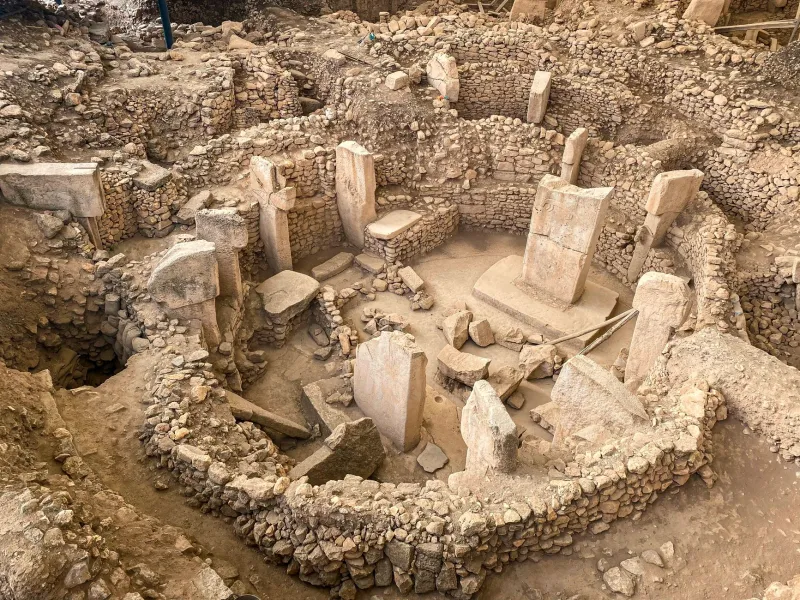
Some of the most important discoveries in American history weren't made by scientists with grant funding and ground-penetrating radar. They were made by regular people with shovels, doing regular things, in regular backyards. Which is exactly how a construction crew in the Midwest ended up accidentally becoming the most important archaeological team in their county — without meaning to, without training, and without any real idea of what they were looking at.
The job was supposed to be simple. Dig down, pour concrete, build a basement. Nobody expected the dirt to fight back.
The Shovel Hits Something
It started with a scraping sound. The kind you hear when a blade clips a rock — except this wasn't a rock. The construction worker who first noticed it almost tossed it aside. People find old junk in the ground all the time: pipes, bottles, the occasional forgotten fence post. This looked like a fragment of something ceramic, darkened and smooth in a way that felt deliberate. Shaped, not broken.
He set it aside. Then he found another one. Then a few more.
By the time the crew stopped to actually look at what they were pulling out of the ground, they had a small pile of fragments, a handful of what appeared to be bone tools, and one nearly intact vessel that nobody on the job site could explain. The homeowner, to their enormous credit, did not shrug and keep digging. They made a phone call instead.
That phone call eventually reached a state archaeologist, who drove out expecting to spend twenty minutes confirming the find was probably 19th-century farm debris. She stayed for two weeks.
What Was Actually Down There
What the crew had stumbled into was a stratified site — meaning the artifacts weren't just old, they were layered. Different depths corresponded to different time periods, stacked on top of each other like pages in a book nobody knew existed. The deepest layers dated back over a thousand years, placing human activity at the site well before European contact and long before the area had been formally studied by archaeologists.
The ceramic fragments were consistent with Mississippian cultural traditions, a sophisticated network of Indigenous communities that flourished across the central and eastern United States between roughly 800 and 1600 CE. The Mississippians are best known for building enormous earthen mounds — some of which still stand today — and for developing complex trade networks that stretched from the Gulf Coast to the Great Lakes. Finding evidence of their presence at this particular location wasn't just interesting. It filled in a geographic gap that researchers had been puzzling over for decades.
Professional surveys of the surrounding region had never flagged the property. No surface indicators. No obvious mounds. Nothing that would have drawn attention. The site had been hiding in plain sight, undisturbed, for centuries — right up until someone decided they needed more storage space.
The Investigation That Followed
Once state archaeologists confirmed the significance of what had been found, the basement project was put on hold indefinitely. A formal excavation was organized, permits were obtained, and tribal historic preservation officers from descendant Indigenous communities were brought in to consult on the process. That last part matters more than it might sound. Under the Native American Graves Protection and Repatriation Act, any human remains or sacred objects uncovered at a site like this carry specific legal and ethical obligations. The excavation wasn't just a scientific exercise — it was also a conversation between the present and communities whose ancestors had lived on that land.
Over the following months, the site yielded an extraordinary range of material: pottery, stone tools, evidence of post structures suggesting permanent habitation, and fragments of trade goods that indicated contact with communities hundreds of miles away. The picture that emerged wasn't of a temporary camp or a seasonal stop. It was a settlement. A real one, with real people who had built something lasting — and then, for reasons archaeology can only partially explain, moved on.
Why Nobody Found It Before
This is the part of the story that tends to make professional archaeologists a little uncomfortable to talk about. The tools exist to find sites like this without accidentally demolishing them. Ground-penetrating radar, LiDAR surveys, systematic soil sampling — these technologies have transformed the field over the past thirty years. But they require someone to look. And looking costs money, takes time, and usually requires a reason to suspect something is there in the first place.
Across the Midwest, thousands of acres of historically significant land sit beneath subdivisions, parking lots, and cornfields, never surveyed, never examined. Some of it has already been destroyed without anyone knowing what was lost. Some of it is still intact, waiting for the wrong backhoe or the right curious person.
In this case, luck landed on the right side. The construction worker noticed something strange and didn't ignore it. The homeowner made the call instead of quietly pocketing the artifacts. The archaeologist who showed up took it seriously.
A Monument to Accidental Preservation
The basement never got built. The homeowner, after working through the legal and logistical maze that comes with owning land that turns out to be archaeologically significant, ultimately agreed to deed a preservation easement on the excavated portion of the property. The site is now part of an ongoing research effort, and some of the recovered artifacts have been repatriated to descendant tribal communities in accordance with federal law.
None of that would have happened if the shovel had swung two feet to the left. Or if the person holding it had been less curious. Or if the homeowner had decided the whole thing sounded like too much trouble.
History gets written in strange ways. Sometimes by scholars in archives. Sometimes by construction crews who notice the dirt isn't behaving the way dirt is supposed to.